Bejgli (Beigli)
Poppy seed and walnut roll- Yield
- 2 rolls (about 24 slices total)
- Active
- 1 hour
- Total
- 3 1/2 hours, plus cooling
- Difficulty
- Medium
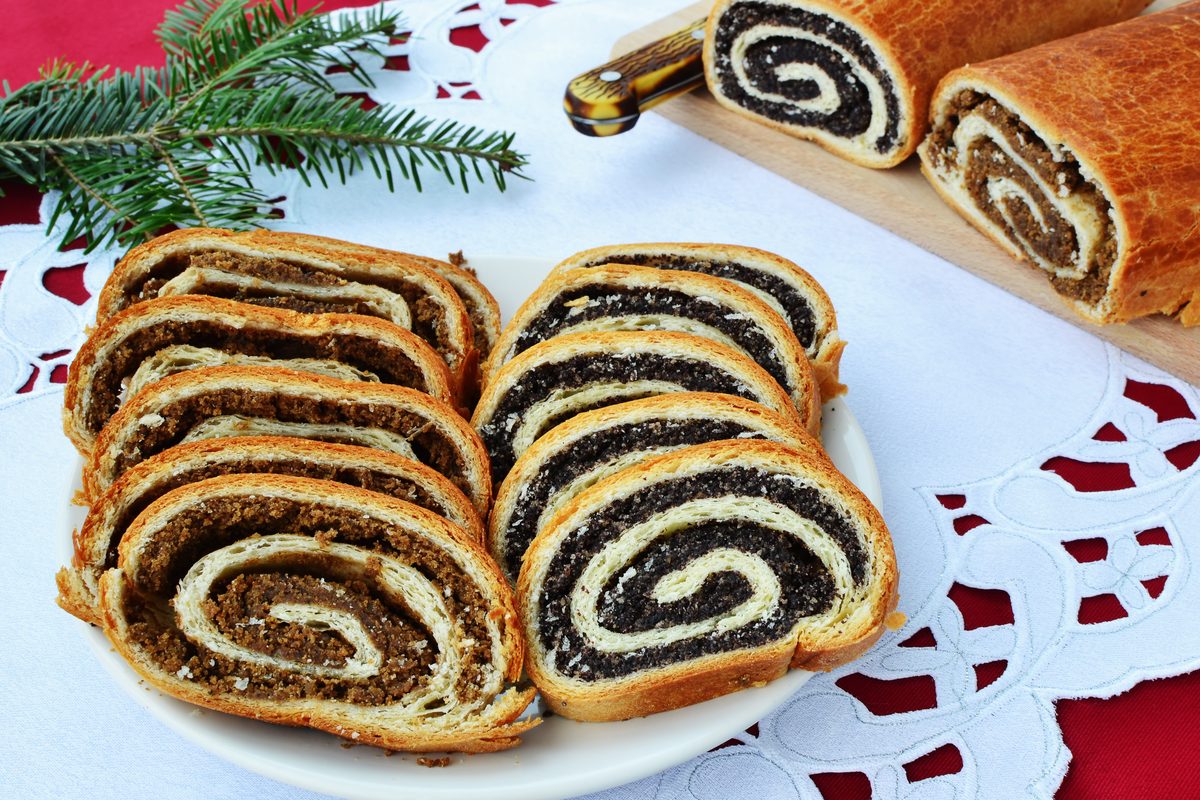
The story
The origins of bejgli, a rolled pastry filled with poppy seeds or walnuts, are shrouded in fog. One theory points to bakers in Pozsony (today's Bratislava) who were selling similar rolled pastries as early as 1559; another links the recipe to the Yiddish word “beigl” and the German verb “beugen” (to bend); a third proposes an Armenian origin. Bejgli reached Hungarian homes only in the second half of the 19th century. Curiously, an old folk belief holds that walnuts protect against hexes, while poppy seeds bring prosperity, so many families bake both kinds “just in case.” Bejgli calls to mind the Jewish flodni, a pastry that holds both of those fillings at once, alongside layers of apple and plum jam, which hints at the shared roots of Central European holiday baking. For Hungarian families in the diaspora, the question of “poppy seed or walnut” on the Christmas table is as much a matter of identity as the recipe itself.
Ingredients and method
The full recipe, with US and metric measures and stand-ins for hard-to-find ingredients, is part of the Christmas edition. Buy it once and keep the PDF.
Want to try first? Mákos Guba is free to cook.